
In this blog post, we will talk about the Multi Scope Recognition framework with the aim of helping corporates successfully report on their SAF purchase without committing double counting.
Emissions Reporting
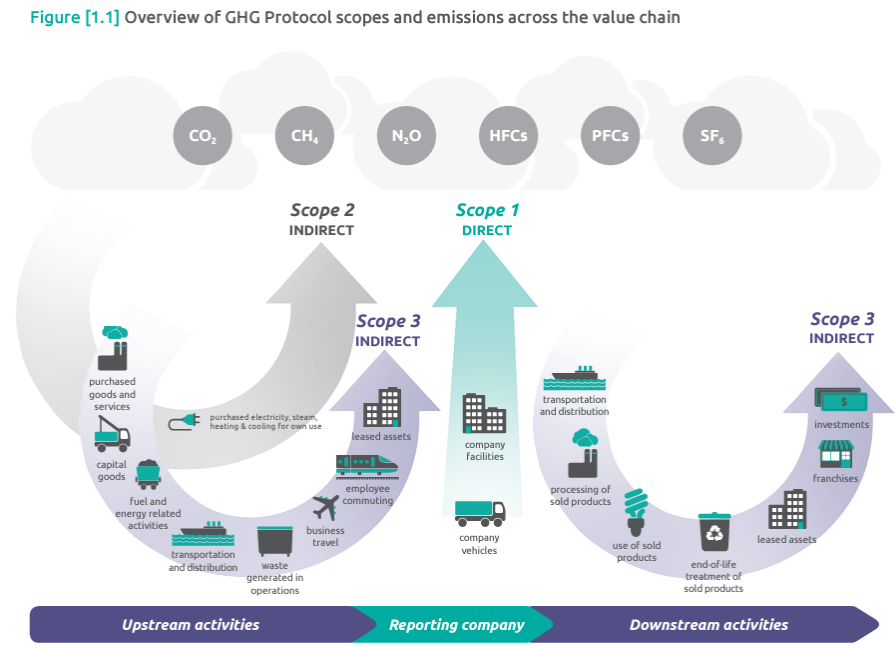
The Greenhouse Gas Protocol (GHGP) is an international standard for corporate emissions accounting and reporting. It categorizes Greenhouse Gases (GHGs) into Scope 1, 2 or 3 based on their source in relation to your company’s emissions.
Scope 1 emissions are direct emissions. Scope 1 emissions come from sources that are owned or controlled by the reporting entity, such as the use of power and the company’s vehicles.
Scope 2 emissions are emissions from generated purchased electricity, steam, and heating/cooling of an entity.
Scope 3 emissions are indirect emissions that are not owned or directly controlled by the entity but are related to its activity. Scope 3 emissions can be, for example, emissions from business travel, air cargo transport, or the use of fuels produced by a third party entity (oil company). This covers both upstream and downstream emissions.
Multi-Scope Recognition
It is important to note that whether emissions fall under Scope 1, 2 or 3 is entirely dependent on the perspective of the reporting entity.
For example, the emissions that result from a plane burning jet fuel fall under the definition of Scope 1 (direct) for the airline that owns the plane, as the emissions are produced as a by-product of their direct operations. However, those same emissions are categorized as Scope 3 (indirect) for the end users (passengers, business travelers or freight) on the plane.
Scope 3 emissions can be reported by multiple entities. In the case of business travel, for example, the same Scope 3 emissions can be included in the sustainability report of the corporate traveler’s reporting, the airport’s reporting, and the service provider’s reporting.
This means that many different entities will report on the emissions of the same quantity of fuel. This is not double counting if the emissions are only reported in one entity’s Scope 1 and in any other entities’ Scope 3 related to that activity. This framework is known as multi-scope recognition.

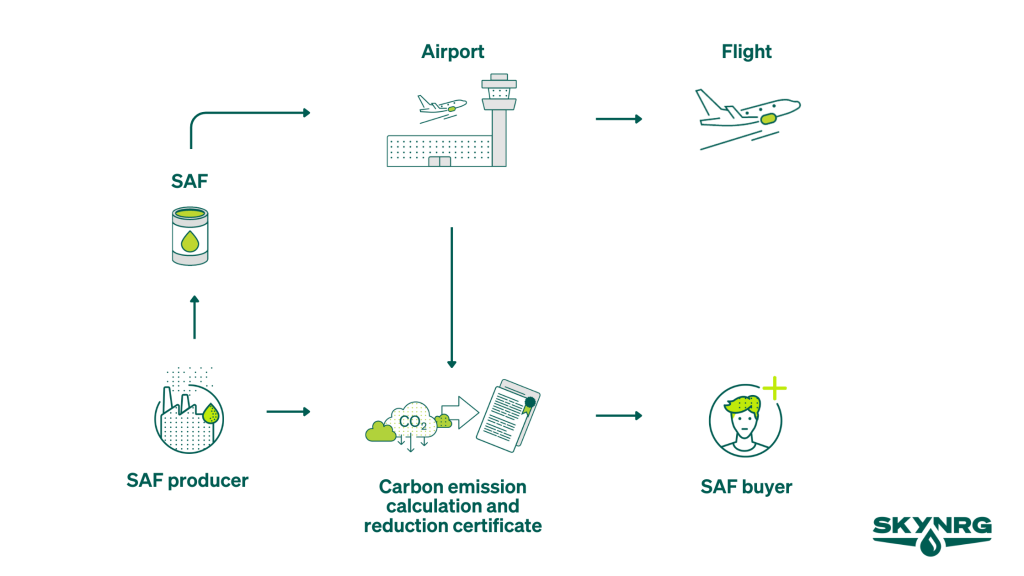
The Multi Scope System allows multiple parties to report on the emissions savings derived from the purchase of Sustainable Aviation Fuel (SAF). The cost of carbon savings is lower when the Multi Scope framework is adopted, because when different entities report on the same carbon savings, the cost (or “green premium”) of those carbon savings can be shared between the parties benefitting from them.
Book and Claim
An important support mechanism for the Multi Scope System is Book and Claim, which allows parties, such as airlines, corporates and freight forwarders, to report on their aviation-related Scope 1 and/or 3 emissions and share the costs and benefits of SAF, without physically using the fuel on their own flights. For more information, click here.
TALK TO US
Want to learn more about SAF and the possibilities for you? Please submit the form and we’ll be in touch with you shortly.